New - 4 Hours Ago





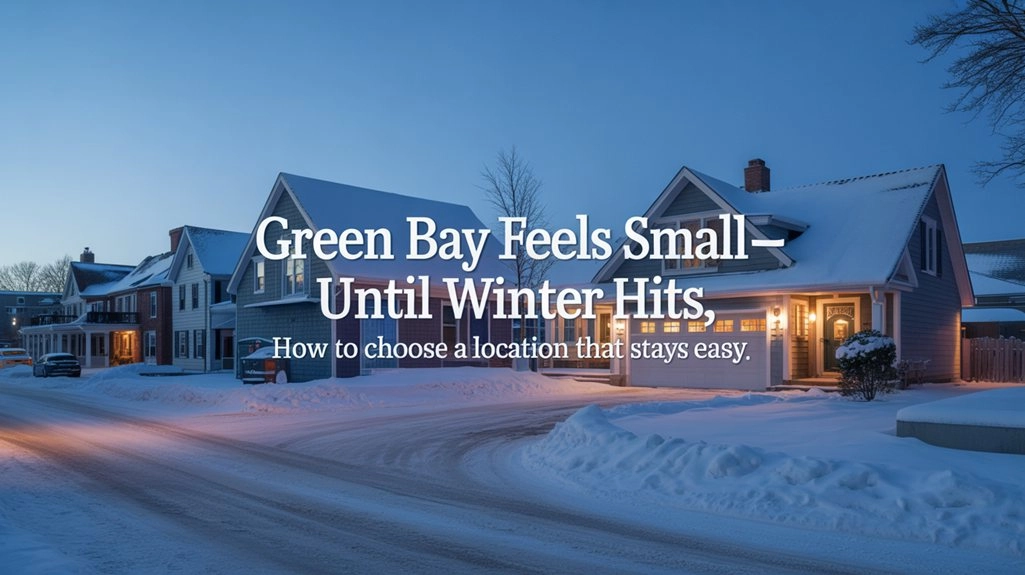
Green Bay can feel wonderfully “easy” when you first arrive. Ten minutes to almost anything. Familiar roads. A city that doesn’t make you fight for every errand. And then winter shows up and quietly changes the rules. Not in a dramatic, scary way—more like a practical reality check. The same place that felt simple in October can feel different in January if your driveway fights you, parking turns into a weekly puzzle, or your first turn out of the neighborhood is always slick and drifted in.
The good news: most of that “winter friction” is predictable. You don’t need to be a snow expert to choose a location that stays easy. You just need to think like someone who’s been here long enough to know where winter shows up first—at the end of the driveway, on residential side streets, in wind-exposed stretches, and on nights when street parking rules tighten up.
And when I say “Green Bay,” I’m talking about Greater Green Bay—the city plus nearby places people realistically cross-shop when they want the week to run smooth, like De Pere, Howard/Suamico, Ashwaubenon, and pockets inside the city like Allouez and Bellevue. In Green Bay real estate, winter ease is one of those things you don’t always notice in a listing—but you feel it every week once you live there.
People moving here are often surprised by how compact the day-to-day footprint is. You can cross town without it becoming your whole afternoon. That part is real. Winter doesn’t erase it—it just adds layers: slower turns, more careful stops, a few extra minutes to clear the windshield, and the occasional “do I really want to drive across town right now?”
When you choose a location with winter in mind, you’re not picking the “best” side of town. You’re choosing a place that supports your normal week even when conditions aren’t ideal.
The win isn’t bragging rights. The win is stepping outside after a snow and thinking, “Okay, this is still manageable.”
And if you’re already comparing the usual short list—East Side vs West Side, De Pere vs in-town, Howard/Suamico vs closer-in neighborhoods, or pockets like Allouez, Bellevue, and Ashwaubenon—winter is a surprisingly clean tie-breaker.
Here’s the easiest way to keep this grounded: don’t start with neighborhood names. Start with what your day actually looks like.
That’s the pattern to pay attention to. Winter comfort is usually decided in the first 300 feet of your day—not the flashy amenities, not the marketing photos. The little things you repeat all season are what shape whether a location stays easy.
If you work, volunteer, have school drop-offs, or just have a set of places you hit every week, write them down. Now imagine the “clean and dry” route you take in summer, and the “I want the simplest route” version you’ll take in winter. Those are often different.
If school drop-off is part of your week, pay attention to whether the route relies on smaller residential streets or if you can stay on a straightforward main road most of the way. In Greater Green Bay, being close to a well-maintained main route can feel like a quality-of-life upgrade in winter—not because you’re far away from everything, but because you’re less dependent on side streets that take longer to settle down after repeated snow.
Even if the drive isn’t long, winter can make it feel longer when it includes extra turns, stop-and-go stretches, or a couple of spots you can’t avoid.
And if your week depends on crossing the river or getting through a couple of busy intersections, winter can turn that into the part of your day you notice most—a slower merge, a longer wait, and more careful driving when the pavement is shiny.
If you want a low-effort way to sanity-check a location, pull up your most-used route on 511WI, then zoom out and ask: “If I had to take the simplest path in messy weather, does this address still make my week easy?”
Then skim the City snow FAQ once—it explains why some blocks and driveway aprons get hit harder than others: greenbaywi.gov/faq.
If you remember one thing from this article, make it this: on showings, pay attention to the driveway like it’s part of the floor plan. It’s not “extra.” It’s part of how the home lives for months at a time.
One winter-specific detail people notice fast is the whole arrival sequence—where you’d step out of the car, how many feet to the door, whether the walkway pinches between landscaping, and whether there’s room to stack snow without turning the front walk into a slick strip.
You’re not hunting for perfection—you’re spotting the parts that turn into daily maintenance.
The city even calls out that driveway aprons are used for snow storage—which is why you’ll see that end pile up during storms. See the official FAQ.
Also worth saying out loud: winter “ease” isn’t only neighborhood. It’s home type, too. A place with a simple entry, predictable parking, and less outdoor maintenance can make the season feel lighter—even if you’re still close to the same stores and routes.
A calm side street, a cul-de-sac, a tucked-in block—those are real lifestyle wins. You can hear yourself think. You get a calmer street without a parade of traffic. The trade-off isn’t “good vs bad.” It’s that residential streets can behave differently than primary routes after multiple storms.
Residential streets are plowed differently than primary routes, and salt isn’t typically used on residential streets. Over time, that can mean packed snow, rutted stretches, and a slower “return to normal” after a run of storms—especially on shaded streets or areas where wind drifts build up. Some winters, the neighborhood street is the part that stays “wintery” the longest, and that’s either totally fine, or it’s the detail that quietly wears on you.
Parking is one of those topics that feels boring right up until winter forces you to care. During snow emergencies, on-street parking is restricted. If you’re looking at a home where the driveway is tight or the garage is shallow, this becomes a real comfort decision.
Check the rules once so you aren’t surprised: Green Bay Snow Emergencies. The goal isn’t to memorize anything—it’s to have a simple plan for where the extra car goes on the nights those rules tighten.
Two blocks can feel totally different in winter. Not because one is “better,” but because exposure changes drifting and refreezing—and that changes how easy it is to walk in, back out, and keep the front path safe without thinking about it all the time.
If a spot is more open—fewer wind breaks, wider street frontage, or a stretch that catches gusts—you’ll often feel it first at the edges: the end of the driveway, the sidewalk, the steps, and the places meltwater likes to refreeze. This isn’t about being nervous—it’s about choosing a route and a block where you feel steady driving home after dark in a storm.
When the roads are messy, most people don’t mind driving—they mind the awkward parts. The unprotected left turn across traffic. The tight side street with snow narrowing it. The stop sign at the bottom of a little grade that always seems slick. Winter convenience is often about choosing a location that makes everyday essentials feel straightforward even when you’re not in the mood to wrestle with it.
Think about your “normal week” basics: groceries, pharmacy, gas, a quick hardware run, maybe a quick stop that breaks up the day. If those are simple from your home—and your route isn’t dependent on a chain of smaller streets—winter feels lighter. Not because winter is easy, but because your routines stay intact.
It’s easy for winter talk to sound negative. That’s not the point here. Winter is part of what makes Green Bay feel like Green Bay—lights on early, a warm kitchen, quiet streets after a snowfall, and that moment when everything looks clean again.
Choosing a winter-easy location is really about protecting the best parts of homeownership: the calm, the comfort, the “this fits us” feeling. When your driveway works, your parking is predictable, your route is straightforward, and your block feels manageable, winter stops being a constant daily snag. It becomes a season you move through with a little more ease.
Bonus: homes that stay easy in winter tend to stay easier to live with—and that practicality usually holds up well when you sell, because the next homebuyer is thinking about the same day-to-day stuff.
Once you know your personal version of “winter-easy”—driveway behavior, parking comfort, and route simplicity—the next step is comparing areas through those exact variables. It’s an easy way to narrow your real estate search to places that match your winter routine, not just your wish list.
That’s where comparisons like De Pere and Howard/Suamico stop being abstract and start being practical. Read those guides with your own “Tuesday after snow” picture in mind, and you’ll make a choice that feels calm all year.
These are the questions that usually come up after you read an article like this—simple, practical checks that help you compare areas without overthinking it.